Basin Dynamics of Irrational Persistence
A Framework for Understanding Societal Inefficiency
Most beliefs don’t survive because they are true. They survive because adopting them is cheap and abandoning them is not.
1. Core Mechanism
Beliefs and behaviors persist in populations not because they are rational, but because of an asymmetry between two costs:
Adoption cost Cₐ: the one-time or ongoing cost of acquiring the belief or behavior
Excision cost Cₑ: the one-time cost of abandoning it
When Cₐ ≪ Cₑ, the belief or behavior functions as a one-way valve. Entry is cheap; exit is expensive. Under these conditions, memes propagate and persist regardless of their truth value or utility.
A critical additional variable is the reward signal R delivered at adoption — social approval, tribal membership, moral self-concept — which can drive Cₐ effectively negative, making adoption not merely cheap but incentivized.
2. Information-Theoretic Consequence
The information content of a belief is inversely related to its adoptability under this framework.
A belief that is free to adopt and tribally rewarded will be held by a population predictable entirely from tribal affiliation. If the belief state of an agent can be predicted from group membership alone, the belief carries approximately zero bits of information about its object. It is not an observation about the world. It is a membership credential.
By contrast, beliefs that are expensive to acquire — requiring direct experience, domain expertise, or sustained investigation — carry high information precisely because they cannot be generated cheaply. Their signal is costly and therefore reliable.
Corollary. The epistemic value of a claim about a subject is bounded above by the cost the claimant paid to acquire it.
3. Taxonomy of Basins
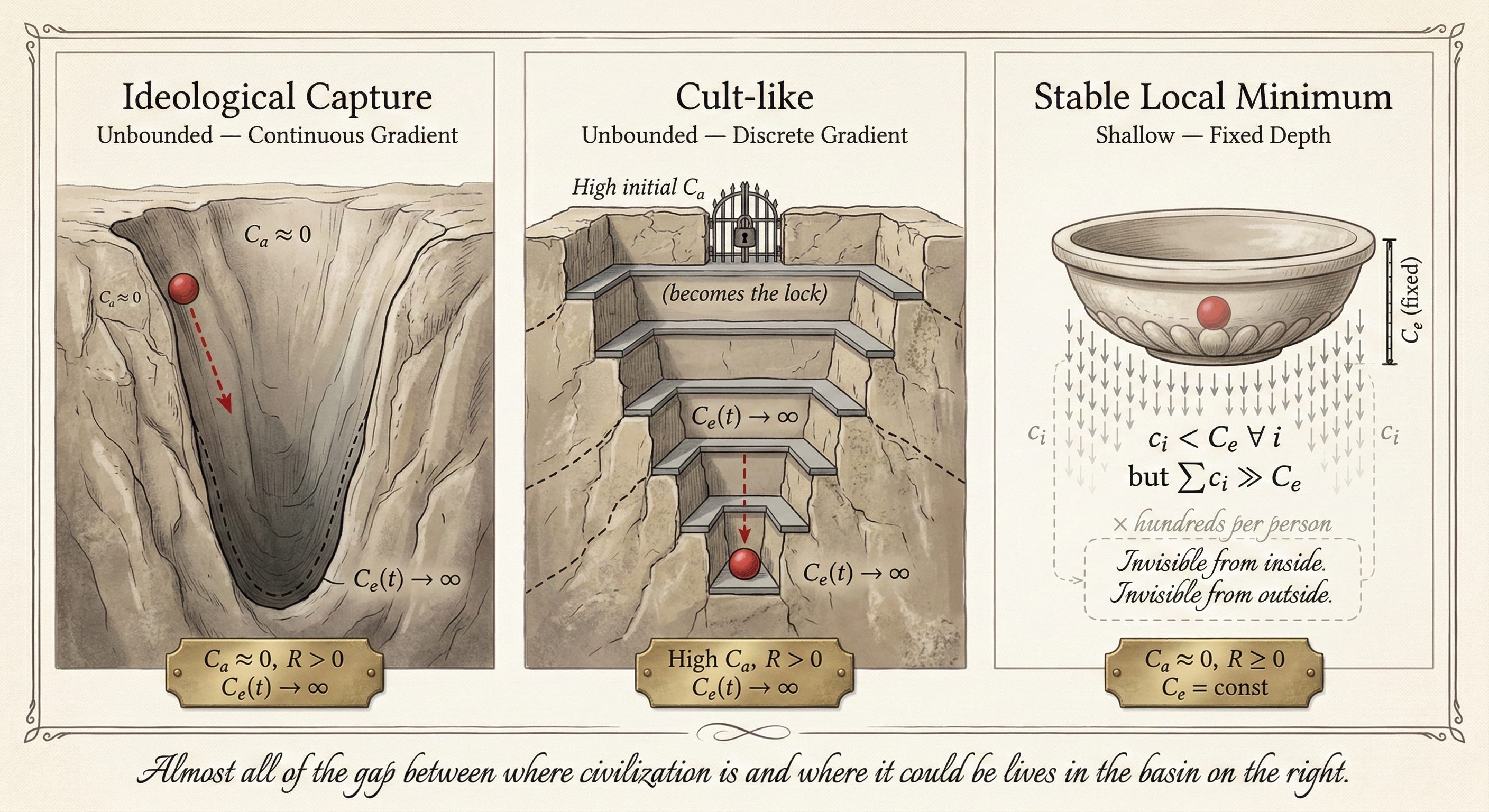
The cost asymmetry produces three qualitatively distinct dynamical regimes, each corresponding to a different basin geometry in the space of beliefs and behaviors.
3.1 Unbounded Basins (Bottomless Wells)
Signature: Cₐ ≈ 0, R > 0, Cₑ(t) → ∞ as t → ∞
The excision cost grows without bound as a function of residence time. The gradient always points downward. There is no equilibrium — the agent descends indefinitely.
Mechanism: Each incremental concession is individually rational (its cost is less than the current excision price), but each concession also raises the excision price. The well deepens with every step.
Subtypes differentiated by gradient shape:
Ideological capture: Continuous gradient. Each position follows smoothly from the last. The agent experiences no discrete discontinuity and may not perceive the descent at all. Entry: free. Five years later: defending positions that would have been unrecognizable at entry.
Cults: Discrete, steep gradient. High initial entry cost that itself becomes the lock via sunk-cost dynamics. Small population, extreme per-capita commitment depth.
Both subtypes share the same sign of gradient (always descending) and the same unbounded excision cost. They differ only in shape.
Key property: Visible from outside. The depth of commitment and extremity of resulting behavior makes these basins detectable by external observers, which partially limits their population reach.
3.2 Stable Local Minima (Shallow Basins)
Signature: Cₐ ≈ 0, R ≥ 0, Cₑ = const > 0, ongoing diffuse costs cᵢ where cᵢ < Cₑ for all i
The excision cost is fixed and finite. The basin does not deepen. The agent sits at a stable equilibrium, paying small recurring costs that individually never justify the one-time escape investment.
Mechanism: The ongoing cost per period cᵢ is real but sub-threshold relative to Cₑ. At no individual decision point does escape appear rational. However, the cumulative cost Σcᵢ over a lifetime may vastly exceed Cₑ.
Σᵢ₌₁ᴺ cᵢ ≫ Cₑ ≫ cᵢ ∀ i
This is a coordination failure across time — each temporal instance of the agent makes the locally rational choice to stay, while the integrated agent over all time periods would choose to leave.
Key property: Invisible from inside and outside. The behavior appears mundane, each individual cost is trivial, and there is no dramatic signal of irrationality. This is what makes this class dominant.
3.3 Population and Impact Distribution
Basin Type Population Per-Capita Depth Visibility Total Societal Cost Unbounded (ideological) Moderate High, growing Moderate Significant Unbounded (cult-like) Small Extreme High Limited Stable local minima Universal Low, constant Near zero Dominant
The overwhelming majority of the delta between actual and potential human flourishing is found in stable local minima — not because any single basin is deep, but because there are hundreds per person across a population of billions, each extracting a small continuous tax that never triggers escape.
4. First Principles Thinking as Basin Escape
The framework provides a precise operational definition of a concept typically left as vague aspiration:
First principles thinking is the conscious, systematic willingness to pay one-time excision costs Cₑ that exceed any individual diffuse cost cᵢ but are exceeded by the cumulative cost Σcᵢ.
This definition immediately explains three observed properties of first principles thinking:
Rarity. The escape cost hurts every single time. The payoff is the integral, which is never visible at the moment of payment. Humans are poor integrators.
Domain generality. First principles thinking is not a skill specific to any field. It is the same operation — basin escape — applied across domains. An agent who does it in one domain has not thereby made it cheaper in another; they have merely demonstrated willingness to pay.
Compounding returns. Each escaped basin frees resources (time, attention, cognitive load) that marginally reduce the effective cost of subsequent escapes. The returns are not to intelligence but to freed capacity. A citizen who pays the excision cost to escape the shallow basin of “DMV lines are just inevitable” suddenly finds the identical pattern visible at the post office — and then across government bureaucracy as a whole; each subsequent escape now costs marginally less in subjective effort, even though the objective Cₑ has not changed.
5. Implications
5.1 Memetic Ecology
The cheapest-to-adopt, costliest-to-excise, most emotionally rewarding memes will dominate public discourse regardless of truth value. This is not a failure of education or intelligence. It is a selection pressure operating on the memes themselves. Memes that survive are those engineered — whether by intent or evolution — to minimize contact with falsifiable reality, because falsifiability introduces a mechanism by which excision cost can be overcome.
Information is objective. Objectivity entails falsifiability. Falsifiability creates an excision pathway. Therefore, the memes best adapted for persistence are those that are maximally unfalsifiable — constructed to have no surface area of contact with physical reality.
5.2 Aggregate Civilizational Cost
If the dominant source of inefficiency is shallow basins that are individually trivial and collectively enormous, then:
Political and cultural attention is systematically misallocated toward the dramatic (unbounded basins) at the expense of the consequential (shallow basins).
Interventions that reduce the cost of escape — better tools for reasoning, better defaults, better institutional design — have a return profile that is diffuse, undramatic, and therefore underfunded relative to its magnitude.
Almost all of the gap between where civilization is and where it could be lives in shallow basins.
5.3 The Perception Problem
The primary bottleneck for first principles thinking is not intelligence but detection. An agent who cannot perceive the basin has no reason to escape it. The cost is diffuse; the basin is comfortable; the escape appears unjustified at every individual moment.
Any mechanism — perceptual, institutional, technological — that makes basin structure visible to the agent changes the cost calculus fundamentally by transforming escape from an unjustified one-time expense into the obviously correct response to a now-salient continuous drain.